


I am a lover of maps. Especially old ones.
Especially real, physical ones printed on brittle, crumbly old paper that smells like fusty tree.
I am a lover of atlases — even just the idea of a conglomeration of places that will make my heart beat faster.
I am even, weirdly, a lover of Google maps — particularly the process of sitting down with the Google map of a new place I am about to visit and exploring it, learning it, and finding what delightful points of interest there are to find in it.
When I started this article, I intended to write about itinerary planning. But as I started to think more about it, I realized: We’re not itinerary planning.
We’re mapping wonder.
And here’s the thing about maps: they don’t show you everything right away. You need to spend some time with the richness of a place before you can unearth the true gems. This is a more valuable part of trip planning; it’s in the deep dive that you’ll find the hidden places, the ones that will form even more of your Heartbeats.
Flashy, touristy places are right there on the surface, the second you start planning — at the top of the list on Trip Advisor. Marked on Google Maps. The real Heartbeat places are beneath layers of talking to people, digging through map after map, and diving down unexpected Internet rabbit holes.
I already had my flight to Switzerland booked when I discovered the main Heartbeat of the trip. It was open-jaw, into Geneva and out of Zurich. I was deep in trying to figure out the puzzle of traversing the country in two weeks: which cities to stay in, which to skip, how long to stay where. Which side of the country would I like better, the French influenced-west or the German-influenced east? And then what about Lugano? I knew I wanted to spend some time in the Alps, of course, but…
I asked friends who’d been. I followed YouTubers who focused specifically on Switzerland. I read pages and pages of websites about traveling there.
And then. A reel captured me. It showed a room with every surface decorated. A rich Rococo style, full of winding, curving balconies and Corinthian columns, stacks of books on two levels and a parquet floor, pyramid-shaped display cases and richly painted ceilings. My eyes went wide as saucers and I immediately looked up the name and location of this place.
The Abbey library of St. Gall, in St. Gallen, Switzerland.
This would be a stop on my trip.
I booked two nights in St. Gallen, not really sure there’d be enough to fill the time, but confident I’d find other things. Shortly I discovered I could get to the Zeppelin museum in Friedrichschafen, Germany, by train and ferry if I liked. Then, while on the trip, two Swiss ladies who shared my food tour on my first day in Annecy, France, told me there was a festival happening — OLMA, the Swiss Fair for Agriculture and Food.
But upon arrival in St. Gallen in the afternoon of the first day, I realized I wouldn’t make it to either of those places, because I’d underestimated the strange beauty of this small Swiss city. I spent the entire afternoon at the library. I listened to each number on the audio tour, fascinated. The exterior grounds of the Abbey and parts of the Alstadt, or Old Town, had numbers, too, and I didn’t have time to finish before the library closed.
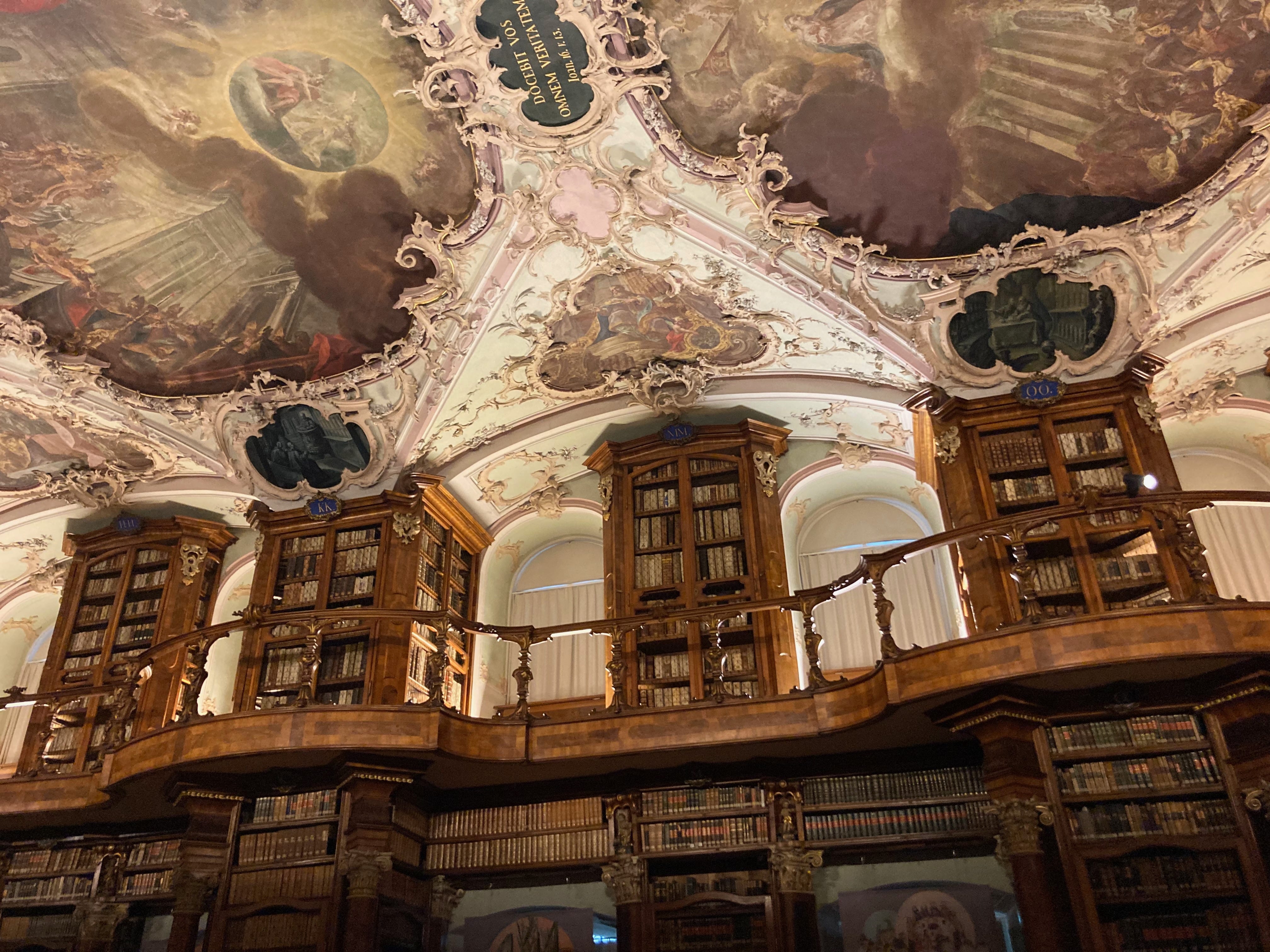
I decided to return the following day, take a free walking tour in the morning (to have someone to ask questions of!), and return to finish the audio guide in the afternoon.
The charm of St. Gallen is a bit of an enigma. The Abbey was built on top of St. Gall’s original hermitage in 719. Because of its lengthy history, it brings together a fascinating mixture of architectural and art styles, a kind of medieval romanticism all wrapped up with Fachwerkhaus (a German architectural style that features exposed wood beams) and featuring oriels (they’re like bay windows that homeowners built to show off their wealth) hanging off buildings throughout the Alstadt.
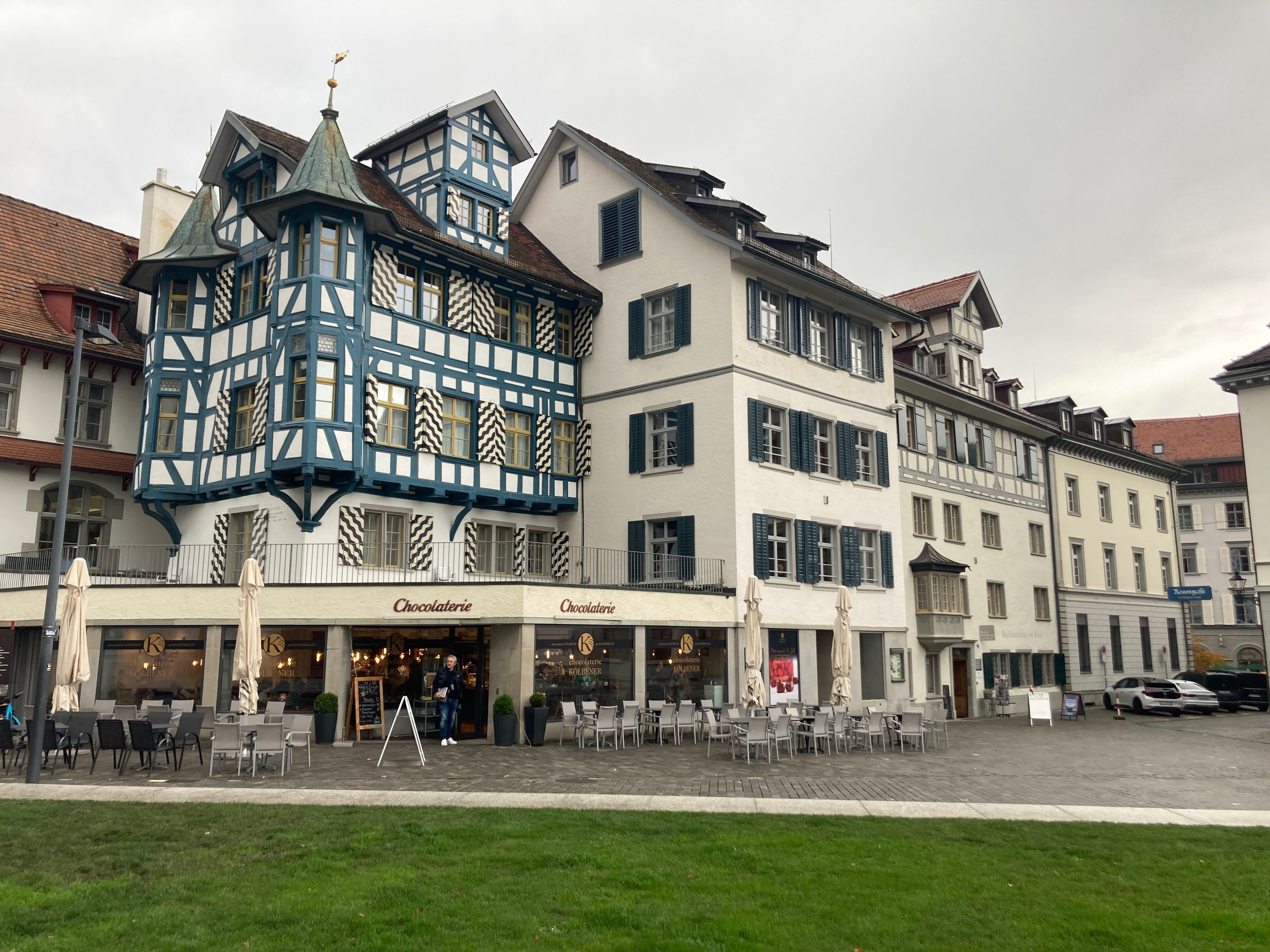
It felt like being inside a Harry Potter novel; I imagine that Hogsmeade looks something like St. Gallen. You’ll find turrets with witches’ hats for roofs and gold weathercocks shining in the rain, whole sections of buildings that stick out of the inner corner of two other buildings, a tall half-rectangle with a sloping roof protruding in front of an otherwise flat rectangular building, with windows precisely aligned and yet decorated with artsy frames. The oriels are covered in intricate wood carvings, and many building faces are painted with splashy murals, sometimes looking half-finished.
And yet, the city doesn’t feel old. Not in the way of some medieval cities that have stagnated. (Bruges, I’m looking at you.) St. Gallen has a fresh, almost younger spirit that feels modern and comfortable and like it has kept up with the 21st century.
Two days was nearly enough time for this personality-rich city, and it was easily my favorite city qua city compared to anywhere else I stayed in Switzerland.
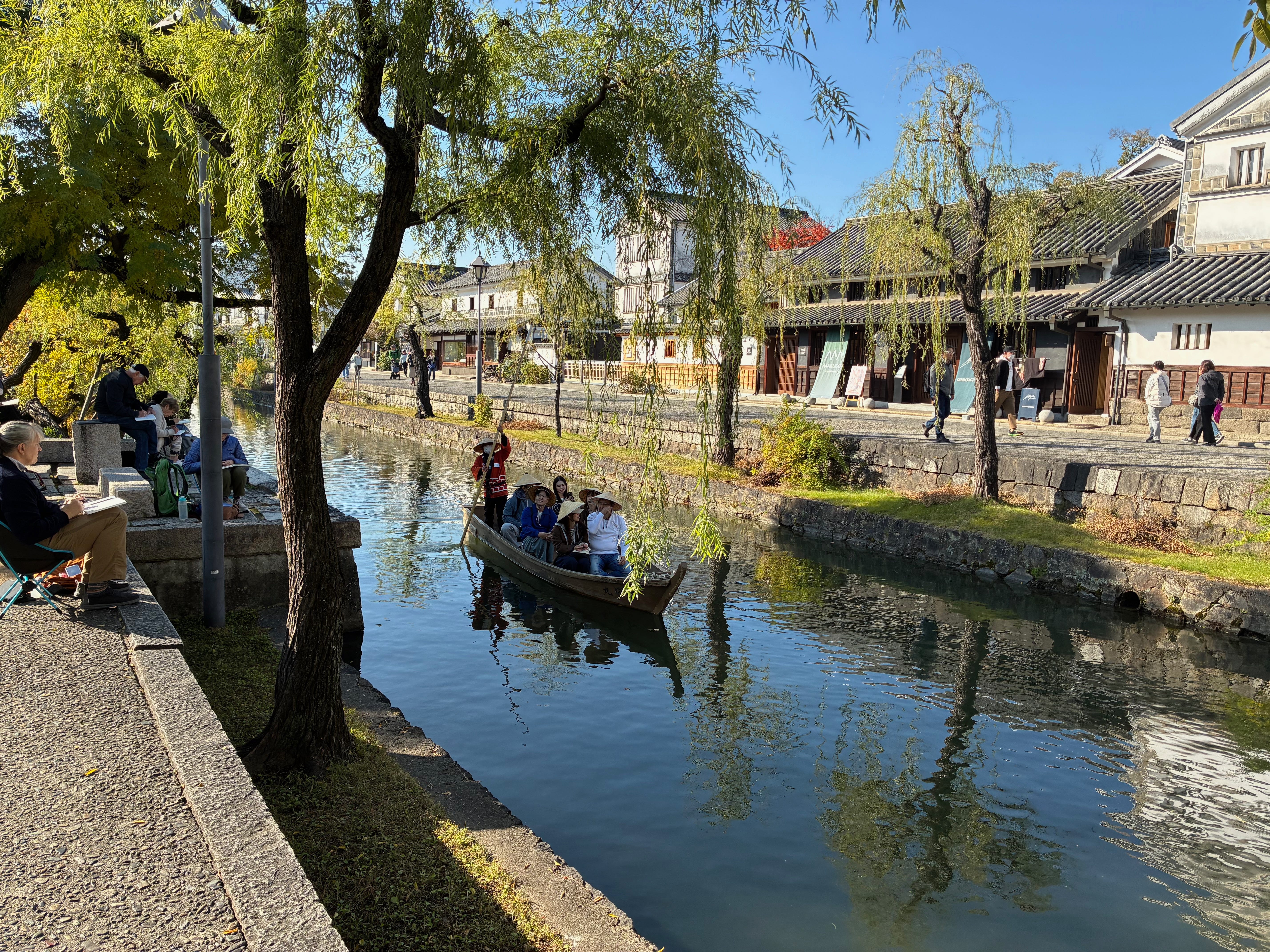
I had a late itinerary arrival when planning my second trip to Japan as well — Kurashiki. Kurashiki (sounds like kurrash-key, not kura-shiki) is a small town outside of Okayama, between Kyoto and Hiroshima. I didn’t have it on my radar until deep into my planning, when someone in one of the Japan Facebook groups mentioned it and shared photos. The photos immediately captivated me, and I started working it into a weekend of my trip when I could stay overnight.
Kurashiki is home to the Ohara Museum of Art, the first collection of Western-style art to be permanently exhibited in Japan — a wonderful melding of cultures that offers delight in its history more than its art (which is sadly influenced by modernist tastes).
It’s also home to the most charming schoolchildren, whose chaperones chased me down in the street to ask for help with answering questions for their English-speaking project. I tried my best to speak a little Japanese, and they tried their best to speak a little English, and I’m not sure we understood each other much at all, but we had a lot of fun trying.
Maps of wonder have layers, and often, the best experiences are farther below the surface.
So when you’re diving in to planning a trip, go deep. Explore all the nooks and crannies. Talk to people. Go down the weird Internet rabbit holes. Study the maps for what they reveal not on the first, second or third looks, but only later, after you know them well.
You’re not just filling activities into holes on a calendar. You’re not just noting down the top 3 places everyone goes to and slotting them in. You’re mapping out your own wonder. You’re preparing the full, rich landscape of your trip. You know that the most interesting places on any map are the ones you have to hunt for — the ones not labeled in big letters, but found instead in the mysterious waters of “here be dragons.”